


Roof Drainage Systems: Components & Types You Should Consider For Your Home
A good roof drainage system is one of the most important parts of your home, even though most homeowners never think about it. Every time it rains, your roof catches gallons of water that have to go somewhere, and the way that water is collected and moved away from your home directly affects your foundation, your siding, your basement, and the lifespan of the roof itself. Understanding the parts and the different types helps you make smarter decisions about repairs, upgrades, and new installations that protect your home for the long haul.
- Why it matters: Good drainage prevents foundation damage, basement flooding, and rotted fascia and soffits.
- What it includes: Gutters, downspouts, splash blocks, drains, and the slope of your roof itself.
- Many style options: Different shapes, sizes, and materials work best for different homes and climates.
What Is a Roof Drainage System?
A roof drainage system is the network of parts that work together to catch rainwater hitting your roof and move it safely away from your home. The whole point is to keep water from running down your walls, pooling near your foundation, or soaking into the ground right next to the house.
How Does a Roof Drainage System Actually Work?
A roof drainage system works in three basic steps: water flows off the roof into the gutters along the edges, the gutters carry the water sideways to downspouts at the corners, and the downspouts send the water down to ground level where splash blocks or buried drain lines move it away from the foundation. The slope of the roof itself does a lot of the work by moving water quickly toward the gutters. When everything is sized and installed correctly, the system handles even heavy rainstorms without overflowing.
- Step one: Water flows off the sloped roof toward the edges.
- Step two: Gutters catch the water and carry it toward the corners.
- Step three: Downspouts move the water down to ground level.
- Step four: Splash blocks or drain lines move water away from the foundation.
Why Does Good Drainage Matter So Much?
Good roof drainage matters because water that doesn’t drain properly is the number one cause of expensive home damage. When gutters clog or downspouts dump water right next to the foundation, that water soaks into the ground, seeps into the basement, rots the fascia and siding, and even causes ice dams in winter. Most of these problems start small and stay invisible for months, which is why a working drainage system is one of the best long-term investments you can make in your home.
According to the Insurance Information Institute, about one in 67 insured homes files a property damage claim caused by water damage or freezing each year, which makes it one of the most common and costly homeowners insurance claims behind only wind and hail damage.
- Protects the foundation: Keeps water from pooling near the base of your home.
- Prevents basement flooding: Stops water from soaking into the ground next to the basement.
- Saves the fascia and soffit: Keeps wood roof edges dry so they don’t rot.
- Reduces ice dams: Clear drainage helps melting snow flow off instead of refreezing.
6 Key Components of a Roof Drainage System
Every roof drainage system is made up of the same basic parts working together. Understanding what each one does helps you spot problems early and make smart upgrades when something needs to be replaced.
1. What Are Gutters?
Gutters are the long channels that run along the edges of your roof to catch water as it comes off the surface. They’re usually attached to the fascia board with hangers and slope very gently toward the downspouts so water flows the right direction. Gutters are the most visible part of any drainage system and the part that most often needs cleaning, repair, or replacement over time. The size, shape, and material of your gutters all affect how much water they can handle and how long they last.
- Main job: Catch water as it runs off the roof.
- Common sizes: 5-inch and 6-inch are the standard residential sizes.
- Materials: Aluminum, steel, copper, and vinyl are the most common.
- Watch for: Sagging, leaks at joints, and overflowing during heavy rain.
2. What Are Downspouts?
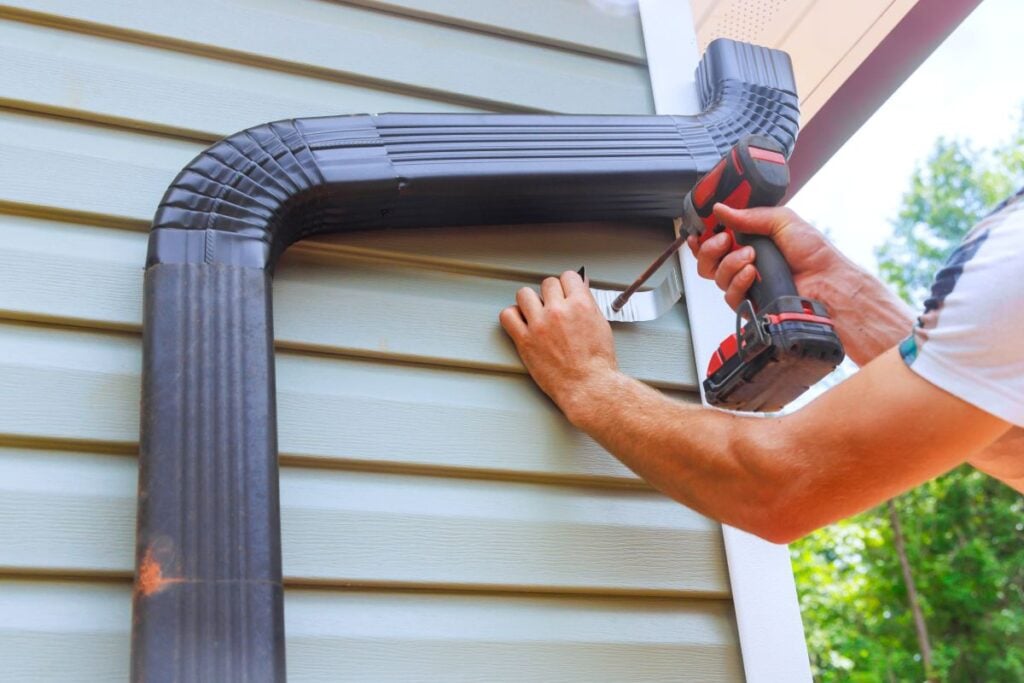
Downspouts are the vertical pipes that carry water from the gutters down to the ground. They attach to the corners of the gutter system and run along the side of the home, releasing water at the bottom where it can drain away. Most homes have downspouts at every corner of the gutter run, plus extra ones on long gutter sections that catch a lot of water. Without enough downspouts, gutters back up and overflow even when they’re perfectly clean.
- Main job: Carry water from the gutters down to ground level.
- Common sizes: 2×3 inch is standard, 3×4 inch handles more water.
- Placement: At every corner and on long gutter runs.
- Watch for: Clogs, separation at joints, and crushed or dented sections.
3. What Are Splash Blocks and Drain Extensions?
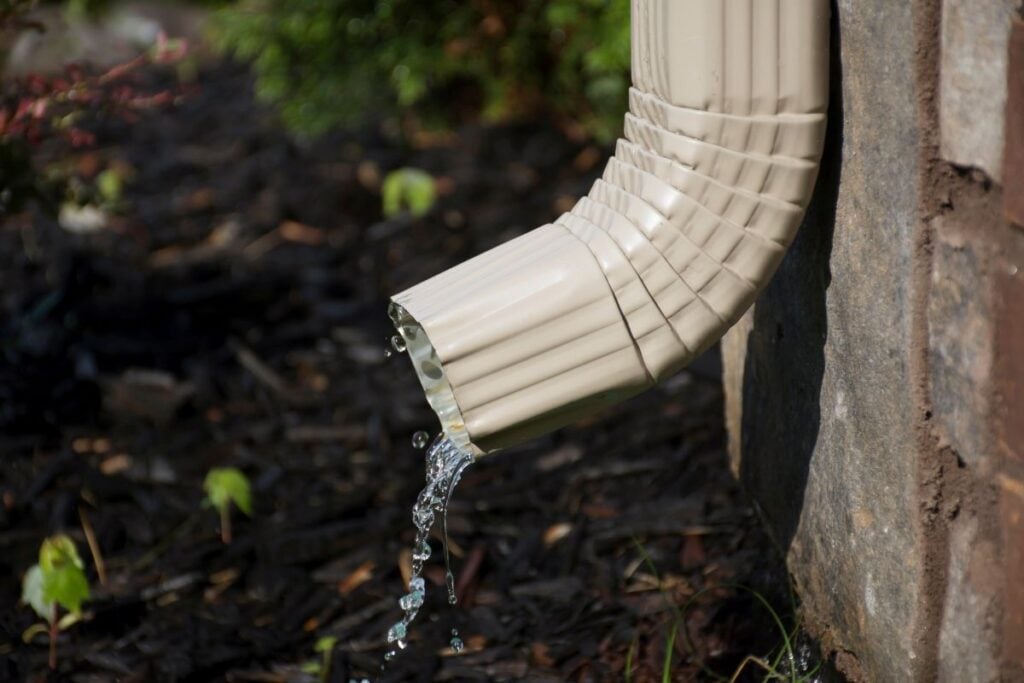
Splash blocks are the small concrete or plastic pieces that sit under the bottom of each downspout to direct water away from the foundation. They’re a simple but important part of the system because they keep the soil right next to your home from getting saturated. Drain extensions take this a step further by piping the water four to six feet away from the foundation, either above ground or buried underground. Either way, the goal is to move water far enough away that it can’t seep back toward the basement.
- Splash blocks: Direct water 2 to 4 feet from the foundation.
- Extensions: Roll-out or fixed extensions move water 4 to 6 feet away.
- Underground drains: Buried pipes move water even farther, often to a street or dry well.
- Best practice: Water should land at least 4 feet from the foundation.
4. What Are Gutter Guards?
Gutter guards are covers that go over the top of your gutters to keep leaves, twigs, and other debris out while still letting water in. They reduce how often you need to clean your gutters and help prevent the clogs that cause overflow and damage. There are several styles, from simple metal screens to fine mesh systems that block even pine needles. Gutter guards aren’t required for a working drainage system, but they’re one of the most popular add-ons because they save so much maintenance time.
- Main job: Keep debris out of the gutters.
- Common types: Mesh, reverse-curve, screen, and foam inserts.
- Cost range: $7 to $20 per linear foot installed.
- Best for: Homes with lots of trees nearby.
5. What Are Fascia and Soffit?
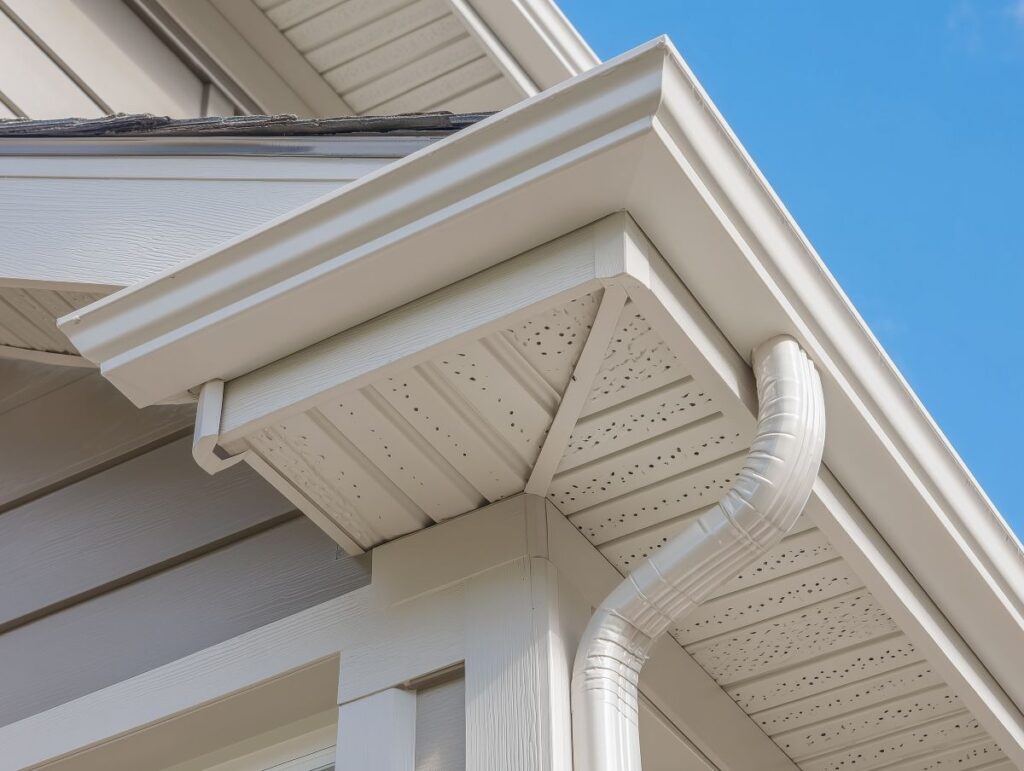
Fascia is the long board that runs along the edge of the roof where the gutters attach, and soffit is the underside of the roof overhang. Together they form the trim around the bottom edge of the roof and play a big role in drainage by giving the gutters something solid to attach to and by hiding the underside of the roof from weather. When fascia rots from water damage, gutters start sagging and pulling away from the home, which is why protecting these parts is part of a healthy drainage system.
- Fascia: The vertical board where gutters attach.
- Soffit: The underside of the roof overhang.
- Common materials: Wood, aluminum, vinyl, and composite.
- Watch for: Soft spots, peeling paint, and stains from gutter overflow.
6. What About the Roof Itself?
The roof itself is the first part of the drainage system, even though most people don’t think of it that way. The slope of the roof, the condition of the shingles or panels, and the way water moves through valleys all affect how well your gutters and downspouts can do their job. A steep, well-maintained roof drains quickly and cleanly. A shallow or damaged roof can pool water, slow the flow into the gutters, and overwhelm the system during heavy rain.
- Roof slope: Steeper roofs drain faster than shallow ones.
- Valleys: Where two roof slopes meet and water flow concentrates.
- Condition: Damaged shingles can slow or redirect water.
- Drip edge: Metal edge that helps water transition cleanly into the gutters.
What Types of Roof Drainage Systems Are Available?
Most homes use a traditional gutter-and-downspout drainage system, but there are several styles to choose from depending on your roof, your climate, and the look you want. Each type has its own strengths.
What Are the Most Common Gutter Styles?
The two most common gutter styles for homes are K-style and half-round, with K-style being by far the most popular in the United States. K-style gutters have a flat back and a decorative front that looks like crown molding, and they hold more water for the same width than half-round gutters. Half-round gutters look more traditional and are common on older or historic homes. There’s also a less-common box style used on commercial buildings and modern homes.
- K-style: Most popular, looks like crown molding, holds more water.
- Half-round: Classic and traditional, common on older homes.
- Box style: Square shape, often used on modern or commercial designs.
- European fascia: Built into the fascia itself for a hidden look.
Seamless or Sectional Gutters?
Seamless gutters are formed onsite from a single piece of metal so there are no joints along the length of the gutter, while sectional gutters come in 10-foot pieces that snap together with connectors. Seamless gutters cost a bit more but leak far less because the only joints are at corners and downspouts. Most professional installations today use seamless gutters because they look cleaner, last longer, and need less maintenance than the older sectional style.
- Seamless: Custom-made onsite, fewer leaks, longer lasting.
- Sectional: Pre-cut pieces snapped together, cheaper, more leak points.
- Cost difference: Seamless usually costs 30 to 50 percent more.
- Best choice: Seamless for most professional installations.
What Materials Should You Choose?
Aluminum is the most common gutter material because it’s affordable, lightweight, rust-proof, and comes in lots of colors. Steel gutters are stronger and handle heavy snow better, but they can rust over time. Copper is the premium option, with a beautiful look that lasts 50 years or more. Vinyl is the budget choice but doesn’t last as long, especially in cold climates where it can crack. Each material has a different price tag, lifespan, and best-use scenario.
- Aluminum: Most popular, lasts 20 to 30 years, $6 to $12 per linear foot.
- Steel: Strong and snow-tolerant, lasts 20 to 25 years, $8 to $15 per linear foot.
- Copper: Premium, lasts 50 to 100 years, $25 to $40 per linear foot.
- Vinyl: Budget choice, lasts 10 to 20 years, $3 to $7 per linear foot.
What Should You Consider When Choosing or Upgrading Your System?
Choosing the right drainage system means thinking about your climate, your roof, your trees, and how much maintenance you want to do. The right setup for one home isn’t always the right setup for another.
How Does Your Climate Affect Your Drainage System?
Climate has a huge effect on what type of drainage system makes the most sense for your home. Areas with heavy rain need larger gutters and more downspouts to handle the volume. Snowy climates benefit from heated cables and ice-resistant materials that prevent ice dams. Hot, dry climates can usually get by with smaller systems, but homes near mature trees still need good debris management. Coastal areas need corrosion-resistant materials like aluminum or copper because saltwater eats through steel.
- Heavy rain: Larger gutters (6-inch) and more downspouts.
- Snow and ice: Heated cables, ice-and-water shield, and ice-resistant materials.
- Coastal: Aluminum or copper for salt resistance.
- Mature trees: Gutter guards reduce cleaning frequency.
When Should You Replace Your Drainage System?
You should think about replacing your drainage system when you see multiple sagging or pulling-away sections, persistent leaks at joints, rust-through holes, peeling paint or stains on the siding below the gutters, or water pooling near your foundation. Most aluminum gutters last 20 to 30 years, so age is also a factor. Replacing the whole system at once costs more than spot repairs, but it gets you matching parts, a fresh warranty, and the chance to upgrade to larger sizes or seamless construction.
- Age: Most gutters need replacement at 20 to 30 years.
- Sagging: Multiple sections pulling away from the fascia.
- Persistent leaks: Leaks that come back even after repairs.
- Foundation problems: Pooling water or basement seepage are big warning signs.
Frequently Asked Questions
How Often Should I Clean My Gutters?
Most homes need their gutters cleaned twice a year, usually once in late spring and once in late fall after the leaves drop. Homes with lots of trees nearby may need cleaning three or four times a year. Gutter guards can reduce cleaning frequency significantly, often to once every one to two years.
How Do I Know If My Drainage System Is Working?
The easiest test is to watch your gutters during a heavy rain. Water should flow freely through the gutters and out the downspouts without any overflow, no streams running over the edges, and no puddles forming next to the foundation. If you see overflow, dripping behind the gutters, or pooling water, something needs attention.
Can I Install a Drainage System Myself?
You can install basic sectional gutters and downspouts yourself if you’re comfortable working from a ladder, but seamless gutters need a special onsite forming machine that only professional installers have. For two-story homes or anything complicated, professional installation is much safer and usually results in a longer-lasting system.
How Much Does a New Roof Drainage System Cost?
A complete new gutter and downspout system typically costs $1,000 to $5,000 on an average home, depending on the size, material, and gutter style. Aluminum seamless gutters fall in the middle of the range, while copper systems are at the high end. Add-ons like gutter guards and underground drain extensions cost extra.
Do I Need Underground Drain Lines?
Underground drain lines aren’t required for every home, but they’re a smart upgrade if your yard slopes toward the house, if you have basement seepage, or if your foundation has had water issues before. They move water farther away from the home than splash blocks alone, which protects the foundation better in heavy rain.
Will Good Drainage Help My Insurance?
Some insurance companies offer small discounts for water mitigation features like extended drain lines and high-quality gutter systems, but the bigger benefit is preventing the kind of water damage claims that drive up your premiums later. Keeping your drainage system in good shape is one of the easiest ways to avoid expensive claims.
Why 5 Star Roofing and Contracting Is the Right Choice for Your Roof Drainage System
A great drainage system protects everything that matters about your home, from the foundation to the basement to the roof itself, and getting it right takes experience and care. 5 Star Roofing and Contracting brings the credentials homeowners look for when protecting a long-term investment, including IKO ShieldPRO Certified Contractor status, HomeAdvisor Top Rated recognition, full licensing, and 24/7 emergency repair availability. Our team walks your property, recommends the right gutter size and downspout placement for your specific home, and installs your system to keep water flowing exactly where it should. Reach out to 5 Star Roofing and Contracting today for a free, no-pressure quote on your roof drainage system and get clear, honest advice on the setup that’s right for your home.


