


Standing Seam Metal Roof Cost: 7 Pricing Factors
A typical standing seam metal roof cost falls somewhere between $10 and $20 per square foot installed for steel or aluminum, which works out to $20,000 to $40,000 on most homes. That’s a big range, and the reason for it comes down to seven specific factors that change from house to house. Knowing what drives the price up or down helps you compare quotes more carefully, avoid hidden add-ons, and make sure you’re getting a fair deal on a roof that should last 50 years or more.
- Average cost range: Most homeowners pay $20,000 to $40,000 installed for steel or aluminum standing seam.
- Premium options: Copper and zinc systems can run $40,000 to $80,000 or more.
- Biggest factor: Material choice has the largest impact on the final price.
Why Do Standing Seam Metal Roofs Cost More Than Other Roofs?
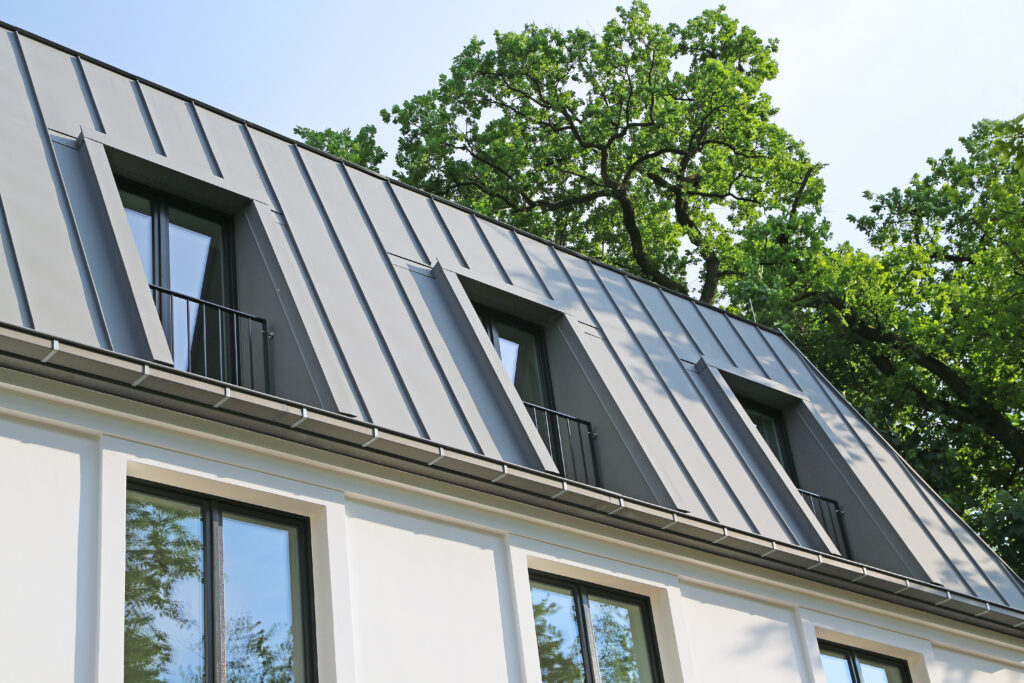
Standing seam metal roofs cost more than asphalt shingles because the materials are higher quality, the installation takes longer, and the system is built to last two to three times as long. The upfront cost is higher, but most homeowners come out ahead in the long run when you factor in lifespan, lower energy bills, and almost no maintenance.
How Does the Cost Compare to Asphalt Shingles?
A standing seam metal roof costs about two to three times as much as a typical asphalt shingle roof. Asphalt shingles run roughly $4 to $7 per square foot installed, while standing seam metal runs $10 to $20 per square foot for steel or aluminum. On a 2,000 square foot home, that’s the difference between an $8,000 to $14,000 shingle roof and a $20,000 to $40,000 metal roof. The premium is real, but so is the longer lifespan.
- Asphalt shingles: $4 to $7 per square foot installed.
- Steel or aluminum standing seam: $10 to $20 per square foot installed.
- Copper or zinc standing seam: $20 to $40 per square foot installed.
- Lifespan difference: Metal lasts 2 to 3 times longer than asphalt.
Is It Worth the Higher Cost?
For most homeowners planning to stay in their home 15 years or more, a standing seam metal roof is worth the higher cost when you look at the full picture. Over a 50-year span, you’d install two or three asphalt roofs versus one metal roof, plus the metal saves you 10 to 25 percent on summer cooling bills and qualifies for insurance discounts in many areas. For short-term owners or homeowners in mild climates with tight budgets, asphalt may still make more sense up front.
According to a Metal Construction Association study based on field inspections of 14 standing seam metal roofs across the United States with up to 35 years of service, a similar roof constructed today using best practices can be expected to deliver a service life in excess of 60 years, which is the kind of long-term performance that justifies the higher upfront cost over a typical ownership window.
- Long-term value: One metal roof versus two or three asphalt roofs over 50 years.
- Energy savings: Cool-rated metal can lower summer cooling bills by 10 to 25 percent.
- Insurance discounts: Many carriers offer 5 to 30 percent off for impact-resistant roofs.
- Almost no maintenance: Far fewer repair calls compared to asphalt.
7 Pricing Factors That Affect Standing Seam Metal Roof Cost
These seven factors are what make one quote $20,000 and another $40,000 on the same size home. Knowing what each one means helps you read estimates more carefully and ask the right questions.
1. What Metal Did You Choose?
The metal you choose is the single biggest factor in standing seam metal roof cost. Steel is the most popular choice at $10 to $16 per square foot installed, and it’s strong, affordable, and works well in most climates. Aluminum runs $11 to $17 per square foot installed and is the right call for coastal homes because it won’t rust. Copper and zinc are the premium options at $20 to $40 per square foot installed, with lifespans of 75 to 100 years and a distinctive look that gets better with age.
- Steel: $10 to $16 per square foot installed, most common choice.
- Aluminum: $11 to $17 per square foot installed, great for coastal areas.
- Copper: $20 to $40 per square foot installed, lasts 75 to 100 years.
- Zinc: $20 to $35 per square foot installed, premium and long-lasting.
2. How Big Is Your Roof?
The total size of your roof is the second biggest factor in the final cost, because more square footage means more material, more labor, and more time. Most homes have between 1,500 and 3,000 square feet of roof surface, and each additional 500 square feet adds roughly $5,000 to $10,000 to the total. Larger homes also tend to have more downspouts, more flashing, and more roof penetrations, all of which add to the cost beyond the panel material itself.
- Smaller home (1,500 sq ft): Roughly $15,000 to $30,000 installed.
- Average home (2,000 sq ft): Roughly $20,000 to $40,000 installed.
- Larger home (2,500 sq ft): Roughly $25,000 to $50,000 installed.
- Roofing squares: Contractors usually price by the square, with one square equal to 100 square feet.
3. How Steep and Complex Is Your Roof?
A simple roof with two slopes is much cheaper to install than a complex roof with valleys, dormers, hips, and skylights. Steep pitches over 8:12 also push labor costs up by 10 to 25 percent because crews work more slowly and need extra safety equipment. A Victorian with twelve valleys and multiple dormers can easily cost 40 to 60 percent more than a simple ranch of the same square footage. Complexity multiplies almost every line item on the estimate.
- Simple roof: Two slopes, no valleys or dormers, lowest cost.
- Moderate complexity: A few valleys and one or two dormers, mid-range cost.
- High complexity: Multiple valleys, dormers, skylights, and roof planes, highest cost.
- Steep pitch: Pitches over 8:12 add 10 to 25 percent in labor.
4. What’s the Condition of Your Existing Roof and Decking?
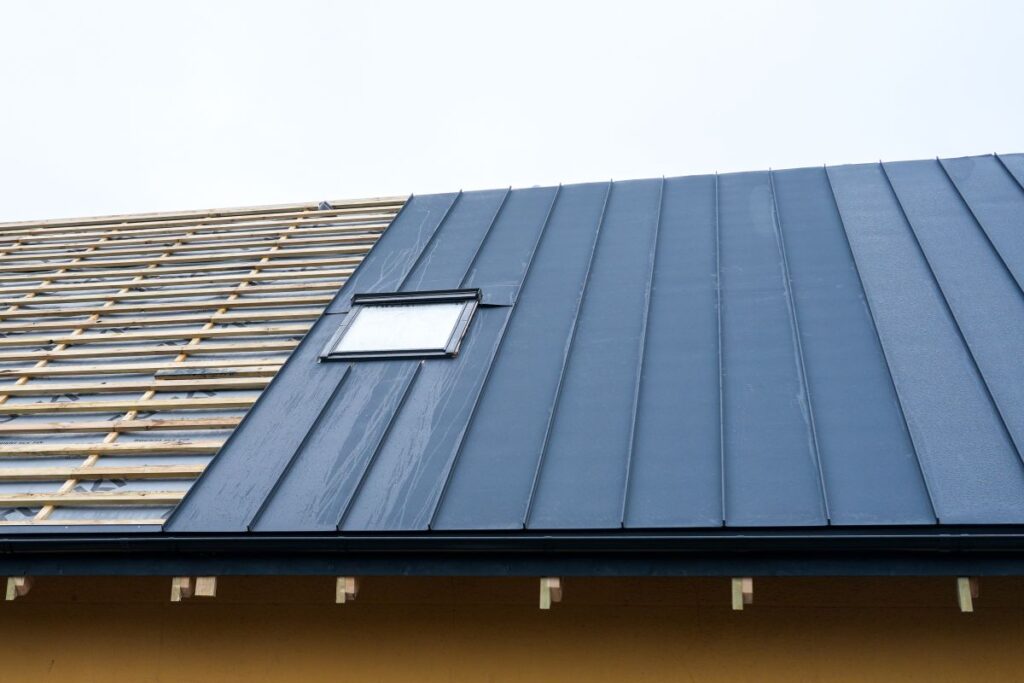
Before any new metal goes on, the old roof has to come off and the decking underneath has to be inspected. Tear-off of existing asphalt shingles adds $1 to $5 per square foot to the total, depending on how many layers and how the material gets disposed of. If the decking has rot, soft spots, or water damage, replacing damaged sheets adds another $70 to $100 per sheet installed. On older homes, 5 to 10 percent of the decking often needs replacement, which can add $1,000 to $3,000 to the total.
- Tear-off: Adds $1 to $5 per square foot to remove the existing roof.
- Decking replacement: Adds $70 to $100 per sheet of plywood or OSB.
- Older homes: 5 to 10 percent of decking typically needs replacement.
- Multiple layers: Tear-off of two or more old roofing layers costs more.
5. What Panel Style and Locking System Did You Choose?
There are two main types of seams on a standing seam roof: snap-lock and mechanical-lock. Snap-lock panels click together by hand and install faster, which keeps labor costs lower. Mechanical-lock panels need a special seaming tool to crimp the joints, which costs more in labor but creates a tighter, weather-resistant seal that performs better on very low slopes and in extreme weather. The panel gauge (thickness) also matters, with thicker 24-gauge panels costing $2,000 to $3,000 more than thinner 26-gauge on a typical home.
- Snap-lock seams: Faster install, lower labor cost, fine for most homes.
- Mechanical-lock seams: Tighter seal, higher labor cost, best for low slopes.
- Panel gauge: Thicker 24-gauge costs more but resists denting better.
- Panel width: Narrower panels look more refined but cost more per square foot.
6. What Coating and Color Did You Pick?
Standing seam panels come with factory-applied paint coatings, and there are two main types. PVDF coatings, often known by the brand name Kynar 500, are the premium choice and hold their color for 30 to 40 years without fading. SMP (silicone-modified polyester) coatings are more affordable but fade faster. PVDF-coated panels typically cost 30 to 40 percent more than SMP-coated panels, but they come with longer paint warranties and look better for longer.
- PVDF (Kynar 500): Premium coating, 30 to 40 year fade resistance.
- SMP: More affordable, shorter color-hold lifespan.
- Cool-rated finishes: Reflective colors qualify for ENERGY STAR and federal tax credits.
- Custom colors: Special-order colors typically add 5 to 15 percent to material cost.
7. Where Do You Live and Who Are You Hiring?
Geography and contractor selection round out the seven biggest cost factors. Labor rates in urban areas of the Northeast and West Coast typically run 30 to 50 percent higher than in rural areas of the Midwest or South. Permit costs range from $150 to $750 depending on the city or county. The contractor you choose matters too, because a licensed, manufacturer-certified installer with strong reviews costs more than a budget crew but protects your warranty and gives you better long-term performance.
- Regional labor: Urban Northeast and West Coast cost the most.
- Permits: $150 to $750 depending on local rules.
- Licensed contractors: Cost more than handymen but protect your warranty.
- Manufacturer certified: Certified installers qualify your roof for the strongest warranties.
How Can You Get the Best Value on Your Standing Seam Metal Roof?
Getting the best value isn’t about finding the cheapest quote, since the lowest bid often cuts corners on materials, fasteners, or warranty coverage. Smart shopping means getting multiple bids, comparing the same scope, and making sure the contractor you choose has the experience to install your roof right.
How Many Quotes Should You Get?
You should get at least three written quotes from licensed local contractors before signing anything. Each quote should clearly list the metal type and gauge, the seam style, the coating, the underlayment, the tear-off scope, any decking allowance, the flashing details, and the warranty terms. Vague quotes that lump everything into one number make it impossible to compare apples to apples. The middle bid is usually the safest choice when all three quotes are from qualified contractors.
- Three minimum: Always get at least three written, itemized quotes.
- Same scope: Make sure each bid covers the same materials and work.
- Licensed and insured: Required for any quality standing seam install.
- Manufacturer certified: Certified installers protect your warranty.
What Should You Watch Out For in a Quote?
Watch out for quotes that don’t itemize the work, don’t list a specific metal gauge, leave the seam style vague, or skip the tear-off and decking allowance. Also be careful of any contractor pushing you to sign on the spot, asking for full payment up front, or offering a price way below the other bids. Quality standing seam work isn’t cheap, and a quote that looks too good to be true usually means the contractor is cutting corners somewhere.
- No itemization: Walk away from quotes lumped into one number.
- High-pressure sales: Quality contractors give you time to decide.
- Full payment up front: Never agree to this. A modest deposit is normal.
- Lowball pricing: Quotes 20 to 30 percent below others usually mean shortcuts.
Frequently Asked Questions
How Much Does a Standing Seam Metal Roof Cost on a 2,000 Square Foot Home?
A standing seam metal roof on a 2,000 square foot home typically costs $20,000 to $40,000 installed for steel or aluminum, with most homeowners landing in the $24,000 to $32,000 range. Copper or zinc systems on the same size home can run $40,000 to $80,000. Final price depends on metal choice, roof complexity, and local labor rates.
Can a Standing Seam Roof Be Installed Over Existing Shingles?
In many areas, yes. Standing seam metal can often be installed over a single layer of existing asphalt shingles if the decking underneath is solid and local code allows it. This can save $1,000 to $2,500 in tear-off costs, but the contractor should always inspect the decking first.
How Long Does Installation Take?
Most standing seam metal roof installations take three to seven working days, depending on the size of the home and how complex the roof is. Simple ranch homes finish faster, while large two-story homes with valleys and dormers take longer. Weather delays are common, especially in cold or rainy months.
Will I Save on My Insurance?
Many insurance carriers offer 5 to 30 percent premium discounts for impact-resistant roofs, and most standing seam metal systems qualify. The discount varies by carrier, state, and policy, so call your agent before installation to confirm what you’ll save.
Are There Tax Credits for Metal Roofs?
ENERGY STAR-certified cool metal roofs may qualify for the federal Energy Efficient Home Improvement Credit, which can reduce your tax liability by up to a few hundred dollars. The exact amount depends on the year, the product, and your overall tax situation. Ask your contractor for the manufacturer’s ENERGY STAR documentation.
Is It Cheaper to Install in the Off-Season?
Some contractors offer discounted rates during slower months, usually late fall and winter. Off-season pricing can save 10 to 15 percent, but installations may take longer due to shorter days and weather delays. Spring and summer are still the most popular times because conditions are more predictable.
Why 5 Star Roofing and Contracting Is the Right Choice for Your Standing Seam Metal Roof
When you understand the seven factors that drive standing seam metal roof cost, it’s clear that the contractor you hire is just as important as the materials they install. 5 Star Roofing and Contracting brings the credentials homeowners need for a long-term roofing investment, including IKO ShieldPRO Certified Contractor status, HomeAdvisor Top Rated recognition, full licensing, and 24/7 emergency repair availability. Our team walks every property, measures every roof plane, and gives you a clear, itemized written quote that breaks down every cost so you understand exactly what you’re paying for. Reach out to 5 Star Roofing and Contracting today for a free, no-pressure quote on your standing seam metal roof and get honest, plain-language guidance from a team that puts your home first.


